Thursday, December 15, 2011

The Help


One of the things I love about reading, be it fiction or nonfiction, is looking through someone else’s perspective. Kathryn Stocket’s The Help does a wonderful job of portraying multiple sides of the same story through her diverse set of characters.

I started reading the help after a recommendation from my mother. She had seen her cousin reading it and so on and so forth. This book has gotten wonderful advertising through word of mouth. It seems that everyone I talk to has at least heard of it, if not read it. It was published in 2009 and the movie version of the story came out this year. I waited to see the movie until after I had read the book, which took some self-restraint, as I kept hearing great reviews of the movie.

Usually, I prefer reading a book with one perspective. One narrator makes the story clearer and more focused, but I think that the choice of having multiple narrators really helped this book. Because there really were multiple sides that needed to be told of this story, the characters’ voices blended together really well to make a 3-D sculpture rather than a 2-D picture. The open-minded Skeeter asks Aibileen, a colored maid, to tell her about her experiences working for white families. As the story was set in Jackson, Mississippi in 1962, that was a very dangerous thing to propose. Stockett, the author, doesn’t sugar-coat the dangerous aspects of the story. The fear felt at many points throughout the book was almost palpable. She provides examples, both fictional and historical, to show that this serious. The good-natured feelings between characters, in their respective social circles, lighten the mood, so it isn’t a dark book. This is the story about the start of change; it displays how one good mind, with a little help, can actually make a difference. It isn’t a depressing book or a horror story. It is historical, inspirational, and quite exciting.

After reading The Help, which took longer than it should have, but the semester was drawing to a close at school and finals were bearing down, I decided it was time to see the movie.

Of course the book was better than the movie. No avid reader can find more than 4 stories where the movie is better than the book, if the book came first. Books always seem more detailed and have more information in them. Movies can bring a book to life, in some ways, but the book will stick in your head longer because it is more in depth than pictures on a screen. Books can express thoughts and feelings and actions in a way that movies somehow can’t. This movie did bring the characters to life for my eyes, but to my mind, they were already incarnate. I see movies as a tool to more deeply understand a book.

I am a history nut. I love viewing events through other people’s eyes. I loved reading this book and I am glad I bought it so I can come back to read it again and again.

Wednesday, November 16, 2011

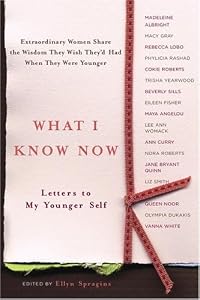
What I Know Now: Letters to My Younger Self


This hasn't happened to me in a long time, pretty much all of my recallable memory. I am now quite disinterested in this book and I want to move on, but I want to justify the time I have not been productive. I have literally carried this book around with me for nearly a month. I received it through my dad's friend on a recommendation.

I am not denying its usefulness or even the idea behind the book, I just can't make myself sit down and read it anymore. I made it to page 171 out of 183 pages. I forced myself to read the past ten pages and I am not gleaning anything from it. Maybe this is due to my hectic lifestyle at the moment, I don't know. All I know is that there are too many good books to read to be stuck one I can't get any further into.

What I Know Now: Letters to My Younger Self is a compilation of letters written by successful women in today's society. This book was put together by Ellyn Spragins but includes letters from women such as Madeline Albright, Maya Angelou, Ann Curry, Nora Roberts, Queen Noor, Vanna White, and Gerry Laybourne. These women are no doubt extraordinary and shine in each of their respective fields. There are a few non-celebrities, such as Carolyn Deaver, a breast cancer survivor. Each woman has an introduction written by Ellyn Spragins which leads into the letter written by each to themselves at a critical time in their life.

This book has boundless possibilities for revealing wisdom to young and old, women and men. I did learn some things from each of the letter writers and I think the book is a success in the sense that it accomplished what I believe its purpose was. I think that the purpose of this book was to compile wisdom from many different outlooks on life. I think that the concept was a great one and I recommend it to anyone wanting a book to read before bedtime, something with short chapters that are packed with meaning for your brain to mull over while you sleep. This book presents little bits of wisdom that will come back to the reader throughout the days after one finishes it.

I would like to conclude this by saying that I was glad to have had the opportunity to have read the wisdom of so many women. If I may, I will add my own bit of wisdom: honest communication is a key element of success. It is a key to a healthy relationship as well as success in a career or in life. Be honest about your abilities and you will never find yourself stretching to fill a lie. One can always grow to greater heights, but do so through honesty.

Please, comment and tell me a bit of wisdom that you have. I want to hear what the world has to teach me.

Tuesday, October 11, 2011

The Jungle


For years I have heard this book referenced in my history and English classes. I guess it just took one more mentioning for me to drive to Barnes & Noble and pick up a copy. It has taken me a while to get through it, but that is only due to my constantly busy schedule. I probably could have finished it in about 5 hours, uninterrupted, if that.

I was expecting a nasty, blood-curdling scene every time I flipped the page. There were some points in the book that made my skin crawl, but it really wasn't too bad. I ended up marking each time that I was really shocked by a post-it and I ended up with about 10. The Junglewas a very good read and I recommend it to anyone who thinks they can read the 357 page book. It is enlightening and engaging. Upton Sinclair takes the reader on a journey from Lithuania to the US packingtown of Chicago. The reader shadows a young man by the name of Jurgis Rudkus, one of the overworked, underpaid, and exhausted millions that went through the town of Chicago in the late nineteenth century into the very early twentieth century. This book specifically takes place, as far as I can tell, from about 1900 to 1904.

Jurgis brings his father and another family over to the US in the search for the land of opportunity. They speak no English except for the word "Chicago" when they first arrive, and end up getting cheated out of nearly everything they own. Jurgis immediately goes to the meat-packing factory and begins working for pennies on the hour. At first he is optimistic and happy that he was selected out of the throng of men begging to work, but after a few months of having one day off a week and working from sun up to sun down on the other six days in dangerous working conditions, he becomes bitter towards the management and the owners of the company. Sinclair illustrates how terribly stressful life is for this family. He shows just how much their lives are left to chance and extortion.

Near the end, Jurgis realizes how much he had in common with the hogs he slaughtered while he worked in the packinghouses. When he first saw the hogs going through the process of being killed and butchered with only a mind for efficiency, he said he was glad not to be a hog. He finds out at the end that the management didn't see humans as much more than expendable cogs in their machine, to be worked until every last dollar was gotten out of them and then to be cast aside without having a second thought for how they will survive.

The last few pages of the book did descend into politics, though, and the story almost completely disintegrated, which is pretty much the only downside to the book.
The Jungle was extremely engaging because it dwelled on one story, one life. It illustrated how full of hope the large family was when they came over, how overjoyed Jurgis was when he could finally marry Ona, a young woman of about 17 from the family he travelled with, and the struggles they endured as the family tried to stay afloat. Tragedy struck again and again until finally, as young Ona is giving birth to her second child, she dies from complications. Jurgis is left with one son, as the other also died in the birth that killed Ona, and works to save the family from starvation. Suddenly, this child dies, after less than 2 years of life, and Jurgis couldn't take it anymore. He left the shattered remains of the family to hobo around the country. He felt clean and happy for the first time since he came to America, but was drawn back to Chicago in the winter, because then there was no work to be done for farmers. I will not give away all of the storyline, but I will say that this story is something that will stay in my mind for a long time. It is no wonder that it had such a huge impact on the US when it was published and that it has become a classic and stayed a popular read for over 100 years.

Tuesday, September 27, 2011

For One More Day


My dad recommended this book to me because it was the first book he has read in a really long time. Normally his 'library'consists of quote books and magazine articles, so I was proud that he read this. I decided to take up his recommendation and also issued a bet. Judging by the weight and thickness of the book, I thought I could read it in under an hour. I was wrong, though. It took me almost exactly 2 hours to finish the 200 page book (including introduction).

I found the book to be touching, but I felt sort of unhappy rather than inspired. The book was written well; I just got that feeling from the storyline.

For One More Day is about a man. 'Chick' Benetto adopts a conversational storytelling tone with the reader in the beginning. The entire story is a series of flashbacks within a flashback. The reader learns about his childhood, his young adult life, and eventually his sad adulthood, where he became so depressed that he attempted suicide (not a spoiler, as it is mentioned at the very beginning of the book).

Most of his story revolves around his parents. His mother, mostly, but his father as well. He reflects on his mother and how he wishes he could have one more day with her. He realized after her death, 10 years before, that he really hadn't appreciated her. His father and mother split when he was young and he was always bitter at his mother for it, but then he realizes that what she tried to do was for the best. His father was the driving force behind Chick, because, as he observes, "Kids chase the love that eludes them, and for me, that was my father's love," (33). Even after his dad was mostly out of the picture, he still chased after what he couldn't attain. His dad's ambition for him was baseball. The only important thing was his son getting to the major leagues. It was more important than school, his friends, his mother, and any job he might hold.

Right after Chick's attempted suicide, he sees his mother. She is standing on the baseball field close to the water tower he jumped off of. Chick looked again and she was gone. He walked to their old house and surprisingly, found her there. She wasn't really a ghost, more like a solid thought. He hugged her and talked to her and she told him things about her life, taking care of him and then living on without him when he became "too busy" for her.

It really is a touching story. Near the end of his one more day with his mom, she was telling him that she loved him and would always be with him. It didn't sound cheesy in the book, it sounded heartfelt.

I enjoyed reading this. I wish that I could've felt more upbeat about it at the end, but the book is what the book is and I am happy to have read it.

Thursday, September 22, 2011

Sins of the Flesh


A friend recommended this book to me when I mentioned other supernatural books I enjoyed. I thought this would be more of an action/lust novel, but it turned out to be a gruesome horror novel. Somehow, I think I became more freaked out by the book than I would a movie. I think it is because when I read a book, the pictures are inside my mind, not on a movie screen.

I am terrible at handling suspense and this book had tons of it. I couldn't stop reading until I was finished. I needed to know if the good guys triumphed and the bad guys died. I won't tell you who won and who died, but the master bad guy is mentioned in the epilogue, giving it a creepy, lingering finish.

Sins of the Flesh by Don Davis and Jay Davis is haunting. I think it is mostly so because it draws on local legends. It mentions a couple cities that anyone around the US has heard of, like Chicago and St. Louis, but it is mostly focused on a little farming community in the boot heel of Missouri, called Gideon. The authors incorporate flashback scenes to draw you into the complex plot even further, and construct a nearly real world around the reader with their detailed imagery. You can almost feel the stifling blackness of night in some of the scenes, and hear the screams of the victims of the wendigo.

The wendigo is the monster in this novel. It is a shape-shifting monster that starts out human, but then acquires a taste for human flesh and when the hunger strikes it, the body of the wendigo turns into a large, hairy, muscular beast that stands nearly 8 feet tall on his hind legs. His very long claws are silver in color and his mouth stretches to 2-3 times the size of a normal human's, with sharp, pointed teeth lining the inside. Not only can he shape shift between his original human shape and that of the beast, he can change into anything. In the book, he impersonates loved ones and victims of his other crimes to draw his new victims in. At the last second, when he has them in his grasp, he changes into the terrifying monster he is. Because it was created by evil magic, only magic can stop it. You will not find the typical witch on a broomstick in this novel, though. Greatness is thrust upon one of the younger characters and I think that makes the story all the more believable. The authors don't sensationalize the common concept of the supernatural, distorting it to a ridiculous proportion, and they keep in mind that the whole idea of a monster and magic are far-fetched, but they draw you right back in with that skepticism.

If you have a weak stomach, I do not recommend reading this. Almost every one of the horrifying deaths brought by the wendigo is described in sharp detail. This is a perfect story to read, if you are fond of suspense, when you are out camping or to retell when you are at home with friends late at night.

I, personally, am not a big fan of horror and suspense, but I will be the first to say that these authors did a fantastic job in writing this book.

Tuesday, September 20, 2011

The Favorites

I am going to start with the favorites of mine so I don't end up getting ahead of myself later.

I own somewhere in the vicinity of 200 books right now. My dream is to have my own personal library in my house, a room devoted to books.

Some of my favorite reads include:

The Adventures of Sherlock Holmes, The Memoirs of Sherlock Holmes, The Return of Sherlock Holmes and The Hound of the Baskervilles, by Arthur Conan Doyle, all conveniently bundled together in an anthology I have.
The Harry Potter series, by J.K. Rowling
The Lord of the Rings series, by J. R. R. Tolkien
The Twilight series, by Stephenie Meyer
Bossypants, by Tina Fey
Heidi, by Johanna Spyri
The Lovely Bones, by Alice Sebold
The Giver, by Lois Lowry
Treasure Island, by Robert Louis Stevenson
Dracula, by Bram Stoker
The Book Thief, by Markus Zusak
The DaVinci Code, Angels and Demons, and The Lost Symbol, by Dan Brown
Black Beauty, by Anna Sewell
Memoirs of a Geisha, by Arthur Golden
Copper Sun, by Sharon Draper
Kite Runner, by Khaled Hosseini
Naked, Me Talk Pretty One Day, Dress Your Family in Corduroy and Denim, and When You Are Engulfed in Flames, by David Sedaris
Assassin, by Ted Bell
One Floew over the Cukoo's Nest, by Ken Kesey
A Million Little Pieces, by James Frey
Pride and Prejudice, by Jane Austen

These are some of the stories that have stuck in my mind the most. I have a few books in my collection that I haven't read yet, and I will get to them in time. I am a college student, taking some pretty reading-heavy courses, so I find myself with less time to read for pleasure than I'd like, but I still manage to get through a book every week or two. I used to be able to finish a 300 page book in one sitting, easily, but time constraints have stopped that for now.

This blog will detail my endeavors and opinions as I march into a sea of literature. I will post each time I finish a book (and maybe more than that) to explain my thoughts on that book. Yes, I will let some spoilers slip! I will warn you, though, before that happens.

Thank you.